

Every morning around the world, hundreds of millions of children sit down at their school desks ready to learn. In Haiti, for too many children, a growling stomach remains a quiet, persistent barrier to that education. At the exact same moment, often just a few miles outside these school gates, local smallholder farmers look over their fields, struggling to find a reliable buyer, or feed their own families.
This parallel struggle is a global challenge with deep local consequences. For decades, the standard response to regional food insecurity—both globally and historically within Haiti—has been straightforward: bring in imported food aid to supply school meals and address immediate hunger. While this approach keeps children fed in the short term, it leaves the underlying systemic issues untouched. It treats school meals as a final endpoint—a band-aid for hunger—while the surrounding local food economy remains fragile, underfunded, and heavily reliant on external intervention.
But what if we looked at this global challenge through the lens of Haiti’s potential and saw an untapped opportunity? What if a school lunch wasn’t just a safety net, but a powerful upstream lever capable of building sovereign food systems and lifting entire communities out of economic uncertainty?
The Evolution: From Local Procurement to Strategic Local Procurement
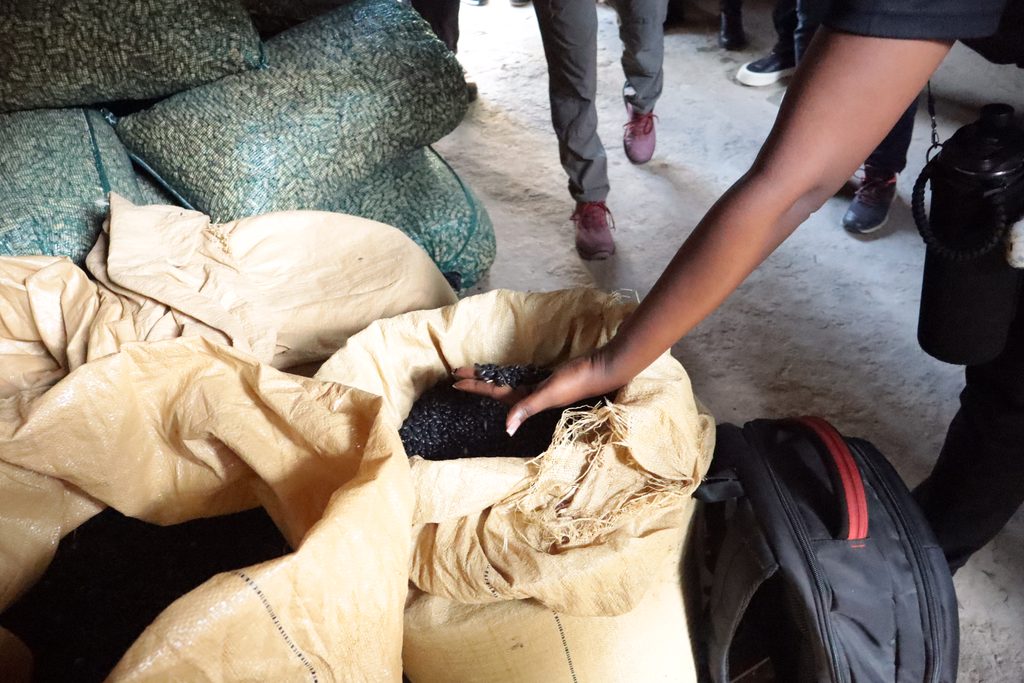
Photo Credits: Acceso
To understand how we can unlock this potential, the evolution of school feeding within the Crisis-Resilient School Meals (CRSM) project can be mapped across three distinct stages.
- School Meals 1.0 focused primarily on the reliable delivery of meals using imported commodities. While this model successfully ensures that children are fed, it creates limited direct demand for local farmers and can inadvertently reinforce a community’s dependence on external supply chains.
- School Meals 2.0 introduced local procurement, creating a direct connection between the school plate and local agricultural production. This brings immediate and important benefits to nearby farmers and local economies, but the purchasing itself often remains short-term or opportunistic. Without predictable demand and complementary structural investments, farmers and suppliers still struggle to build the long-term capacity required to serve institutional markets consistently.
- School Meals 3.0 asks a completely different question: What if school feeding could be deliberately designed to strengthen the food system around it?
Rather than viewing local procurement as the ultimate end goal, School Meals 3.0 treats it as a starting point. The model explores whether predictable, long-term demand for local food—combined with coordinated investments across production, aggregation, processing, storage, distribution, school kitchens, and markets—can create a self-reinforcing cycle of growth and resilience.
This distinction is vital. School Meals 3.0 does not change the primary, sacred purpose of school feeding. Children always come first.
Why Resilience Matters in Haiti
For Haiti, the question of food system resilience is not an abstract academic exercise. Local food production and distribution are regularly disrupted by political and economic instability, climate and weather shocks, extreme price volatility, insecurity, and severe blockages in transportation and markets. These daily pressures make it incredibly difficult for farmers to get their products to buyers, and equally challenging for schools to consistently access the food they need.
The result is a painful, repeating cycle: local producers struggle to find reliable markets, while schools and other institutional buyers struggle to find reliable local suppliers. Strengthening the connections between the two addresses both challenges simultaneously.
There is already clear evidence that local school feeding supports local economies. The World Food Program (WFP) has well-documented how purchasing from local farmers gives producers a predictable outlet for their products while keeping more food spending within Haiti. But School Meals 3.0 goes one critical step further. It explores whether investing directly in the capacity of the entire system—not just purchasing the food—can make local school feeding profoundly more reliable and sustainable over time.
This transformation begins directly with the students. School meals guarantee an attendance rate of over 90% for children who know a hot meal is waiting for them every single day, turning the school kitchen into a primary driver of education. Crucially, when these meals are sourced directly from local production, we can ensure that children are getting a deeply nutritious meal. Unlike imported commodities that sit in storage or transit for months, local ingredients are fresh, minimally processed, and culturally appropriate, providing the exact micro- and macronutrients growing children need to stay healthy and focused.
Knowing there is a guaranteed institutional buyer means local farmers can finally plan for the future, confidently investing in better inputs, tools, and labor to turn unpredictable farming into a stable career. This predictability ripples down the entire supply chain, providing steady income for local truck drivers, crop aggregators, and processing facilities, which expands the community’s capacity to store and move food. As these local supply chains stabilize, food costs become more competitive with imports, allowing teachers to focus on helping healthy, present children thrive.
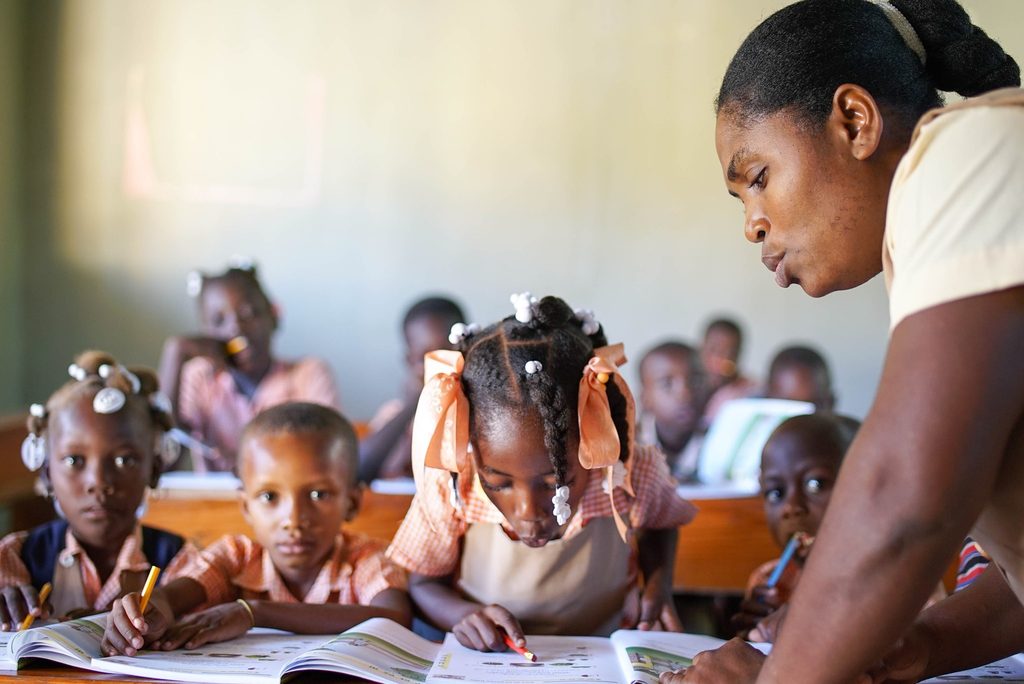
Photo Credits: Summits Education
What is Being Tested?
A system looks beautiful on paper, but it matters most when put into practice. The CRSM Pilot is actively testing this framework in Haiti’s Central Plateau, exploring whether this approach can generate real, measurable improvements in people’s lives beyond the classroom walls. An ambitious systemic transformation requires deep, cross-sector collaboration, and the CRSM Haiti Pilot thrives because of a uniquely aligned coalition of local experts, international researchers, and implementation specialists.
The Haiti Food System Alliance (HFSA) coordinates implementation, scaling, reporting, and communications to tie the entire strategy together, while Summits Education ensures seamless operational integration across its vast network of schools in the Central Plateau. Concurrently, Acceso works on the ground to help farmers grow more, sell more, and earn more through technical assistance, financing, inputs, and connecting local supply directly to Summits Education as well as other buyers in Haiti. To safeguard operations against unexpected crises, World Central Kitchen collaborates closely with Summits Education to establish a specialized resilience hub to enhance community crisis response capabilities. Finally, the Global Food Institute (GFI) at George Washington University leads the research and analytics, working alongside local stakeholders to map the food system, leverage data for proactive decision-making, and systematically monitor improvements in food system resilience.
Supported by the visionary backing of The Rockefeller Foundation Catalytic Capital, The Longer Tables Fund, and the W.K. Kellogg Foundation, this pilot is treating its regional implementation as a proof of concept for the world.
Why It Matters: A Meal is the Beginning of Something Bigger
At its core, School Meals 3.0 represents a profound global shift in how we think about human dignity and resilience. It proves that we do not have to choose between feeding a child today and building a stronger economy for tomorrow. School meals are often understood strictly as a safety net—a way to ensure children have access to food so they are better able to learn. They are that, but they can be so much more.
When school feeding is connected intentionally to local agriculture and markets, every single meal becomes part of a larger, living economic system. The food purchased for that plate represents stable income for a farmer, revenue for an aggregator, meaningful work for a processor, business for a local distributor, and direct investment in community infrastructure.
The potential is particularly important in a country like Haiti, where strengthening local production and reducing vulnerability to external supply disruptions are central to building a sovereign food system. But the opportunity is not simply about replacing imported food with local food. It is about building the capacity for local food systems to work better. That means creating the conditions for farmers to produce consistently, businesses to grow, markets to function, and schools to procure and prepare nutritious food reliably. It means moving away from isolated, temporary transactions and moving toward deep, lasting relationships across the entire food system.
Learning Our Way Toward Resilience
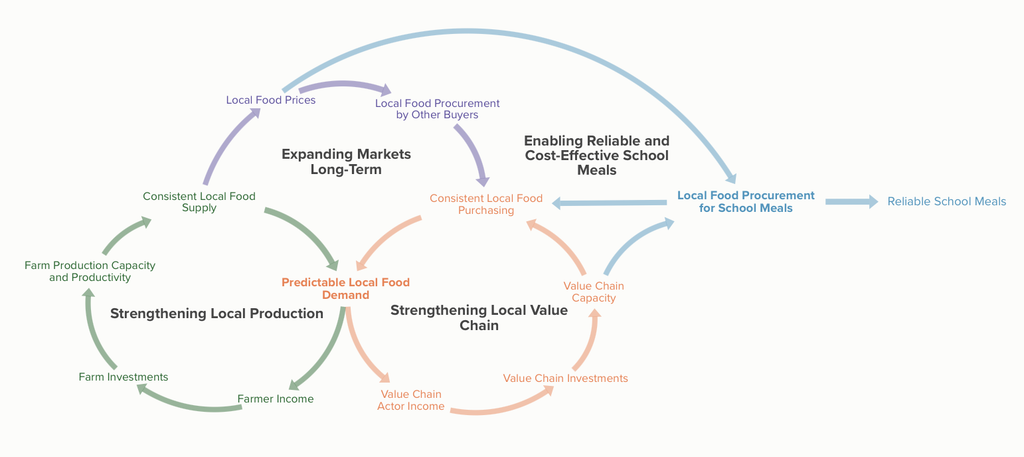
Conceptual diagram illustrating how four core drivers can be jumpstarted with local school feeding. Credit: Global Food Institute
School Meals 3.0 is actively being tested. The CRSM Haiti Pilot is helping us learn what works, what does not, and exactly what types of investments are needed to make this model viable in the long run. The goal is not to suggest that a single approach can instantly solve the complex, interlocking challenges facing Haiti’s food system. It is to test a fundamentally different way of thinking about an existing, essential, and trusted institution: the school meal.
A predictable meal creates predictable demand.
Predictable demand creates incentives for investment.
Investment strengthens farmers, businesses, markets, and infrastructure.
And stronger systems are far better prepared to withstand the shocks that will inevitably come.
In that sense, the ultimate ambition of School Meals 3.0 extends well beyond any single border. By proving that a school kitchen is not just an endpoint for aid, but an active, local economic engine, we can unlock a repeatable blueprint for global development, proving that a school meal is a launchpad for a resilient, well-nourished future.
Want to learn more about School Meals 3.0? Explore the full introductory brief, From Aid to Engine: Reimagining School Feeding as a Driver of Food System Resilience, hosted on the Global Food Institute Website