
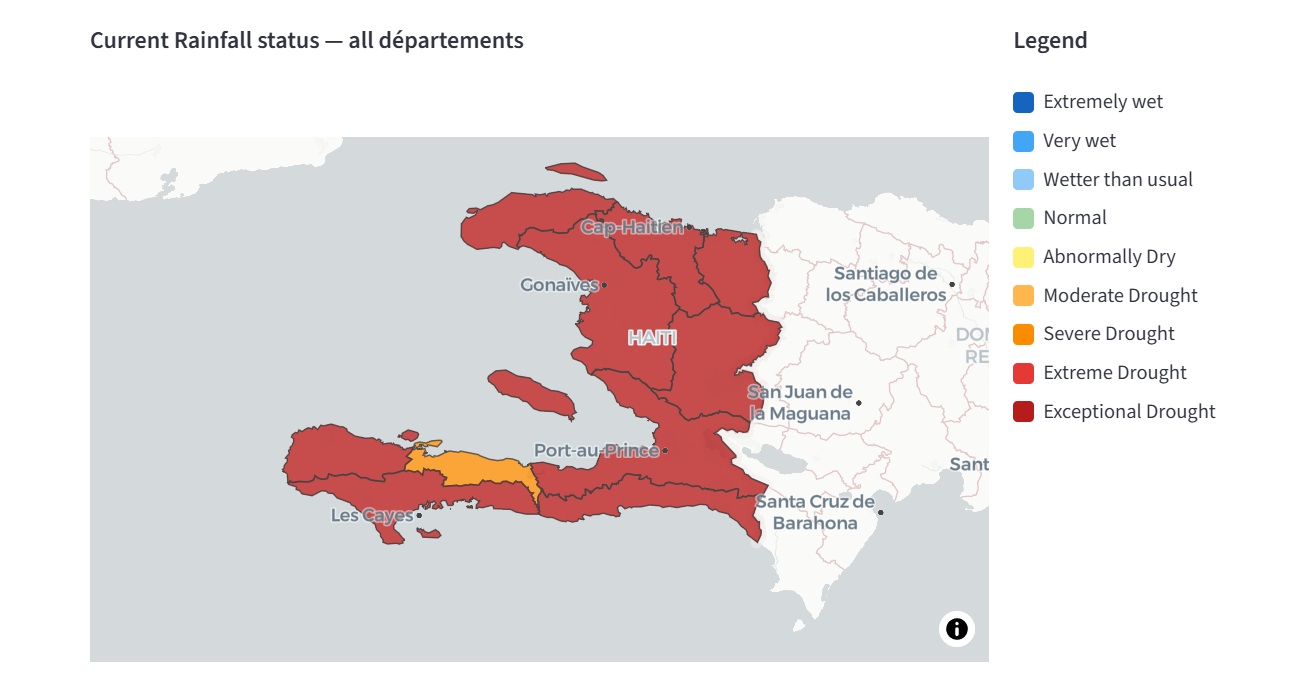
Haiti, September 2026 — Across Haiti, farmers, agricultural organizations, businesses, nutrition programs, and communities are feeling the effects of months of insufficient rainfall and unusually high temperatures.
Crops are struggling without enough water. Farmers are seeing yields decline while production costs rise. Livestock producers are having difficulty finding enough water and forage, and poultry producers are dealing with heat stress. Local food supplies are under pressure. Nutrition and school feeding programs are increasingly concerned about what is happening in agricultural production. Along Haiti’s coasts, communities are also dealing with changes affecting fisheries and other natural resources that rural livelihoods depend on.
For the Haiti Food Systems Alliance (HFSA), these are not separate problems. They are different parts of the same challenge: a climate shock can quickly become a food-system shock.
And the current situation makes the need to act increasingly clear.
HFSA members bring together experience from farmers, agricultural organizations, research institutions, businesses, nutrition and health organizations, financial actors, and other food-system partners. Together, they are looking at what is happening on the ground—and what can be done before today’s challenges become tomorrow’s deeper crisis.
That is why HFSA is making integrated agricultural risk management and producer resilience a central priority.
The goal is not simply to respond to this drought. Haiti needs to move beyond repeatedly responding to disasters and toward building systems that can anticipate risks where possible, reduce their impact, help families recover when shocks occur, and protect production, incomes, and markets over time.
The 2026 Drought is Already Affecting Haiti’s Food System
The current conditions are serious.
FEWS NET reported at the end of July that erratic rainfall and below-average precipitation had affected much of Haiti for more than 70 days. Rainfall deficits had persisted across much of the country for more than two consecutive months. At the same time, high temperatures were increasing moisture stress, degrading vegetation conditions, and threatening both crop establishment and subsequent planting seasons.
The broader climate outlook adds another layer of concern. On September 3, the World Meteorological Organization reported that El Niño is firmly established and expected to intensify into a very strong event. WMO forecasts indicate a nearly 100 percent likelihood that El Niño will persist through February 2027, with the potential to significantly alter rainfall and temperature patterns and increase the risk of drought, extreme heat, floods, and other extreme weather in different regions.
These climate pressures are arriving at a time when Haiti is already facing extremely high levels of food insecurity. Current World Food Program figures indicate that approximately 5.8 million Haitians are facing acute hunger, including more than 1.8 million at emergency levels.
Haiti’s limited capacity to absorb additional shocks is also reflected in international climate assessments. The latest ND-GAIN Country Index ranks Haiti 178th globally, reflecting both high vulnerability and very low readiness to turn investment into effective climate adaptation.
These numbers help put the current situation into perspective. They also make the case for investing in resilience now, rather than waiting for the next crisis.
HFSA Members Are Seeing The Impacts Firsthand
Across the Alliance, members are seeing how drought and heat move through the food system—from farms and livestock to markets, household incomes, schools, and children’s nutrition.
PDL reports that farmers are struggling to maintain crops even in areas located near irrigation canals. Declining production is making it harder for farmers to repay agricultural loans, while competition for increasingly scarce water is adding pressure within farming communities.
Kore Foundation is seeing growing heat stress in poultry production, with producers having to travel farther to secure water for animals. The organization also reports losing more than half of approximately 17,000 vegetable seedlings produced in its greenhouse during the drought.
Acceso reports that some farmers are responding to uncertainty by keeping portions of limited harvests for their families or delaying sales in the hope of getting better prices. These are understandable choices for households trying to manage risk. But when this happens to many producers, less food reaches local markets and institutional buyers.
ACAPE is reporting serious effects on both crops and livestock. Farmers are facing lower yields while also taking on additional costs, including paying workers to irrigate crops manually. At the same time, livestock producers are dealing with growing shortages of water and forage.
Summits Education has highlighted what these agricultural disruptions could mean for school feeding. Organizations participating in these initiatives collectively serve an estimated 70,000 to 80,000 children. A shock that begins in agricultural production can therefore eventually affect tens of thousands of children who depend on these programs for meals.
And the impacts are not limited to agriculture on land. CHIBAS reports that coastal fishing communities are seeing lower catches during periods of higher water temperatures, adding another layer of risk for families whose livelihoods and diets depend on fisheries.
Taken together, these experiences tell a clear story. A lack of water can reduce production. Lower production can mean lower income and difficulty repaying loans. Reduced supply can put pressure on markets. Market pressures can affect access to food. And all of this can increase pressure on school feeding and nutrition programs.
Water, seeds, soil, livestock, fisheries, forests, finance, markets, nutrition, and household incomes are connected. Our response must take those connections into consideration.
From emergency response to integrated risk management
For HFSA, Haiti needs to make a fundamental shift: from reacting to agricultural disasters toward managing risk before, during, and after shocks.
That starts with the realities farming families are facing.
Some climate risks can be prevented or reduced through better technologies, resilient varieties, improved soil and water management, more diversified agricultural systems, and better information.
Other risks cannot be eliminated. They need to be shared or transferred through appropriate financial instruments, insurance mechanisms, and risk-pooling arrangements.
And when a shock does occur, farmers and other food-system actors need systems that allow them to maintain or quickly restore production, income, and access to markets.
For HFSA, this means bringing several pieces of the resilience agenda together.
1. Build a strong Haitian seed system
Farmers cannot adapt to a changing climate without reliable access to quality seed.
Haiti needs a functioning national seed sector that can produce, multiply, and distribute quality seed while developing and evaluating varieties suited to Haitian production environments. This includes varieties that are tolerant or resistant to drought, heat, pests, diseases, and other biotic and abiotic stresses.
Research institutions, local seed enterprises, producer organizations, and distribution networks all have an important role to play.
2. Diversify agricultural systems and protect natural resources
Farming families are more exposed when their livelihoods depend on a single crop, production system, or source of income.
Diversified cropping systems, livestock integration, agroforestry, forestry, and appropriately managed fisheries can help spread risk while protecting the natural resources that future production depends on.
For coastal families, and for communities whose livelihoods depend on forests and agroforestry systems, climate adaptation must serve two purposes at once: protect livelihoods today and protect the resources needed by the next generation.
3. Invest differently in water
Water management will be one of the defining challenges for Haitian agriculture as the climate changes.
Rehabilitating and improving irrigation systems where appropriate will be part of the answer, but it cannot be the whole answer. Haiti also needs to look at rainwater harvesting, water storage, efficient irrigation technologies, watershed management, better water governance, and innovations that can work for farms of different sizes and economic realities.
HFSA also sees an opportunity to develop business models that can bring proven water technologies to scale, including through entrepreneurship, local service providers, and innovation or incubation mechanisms.
4. Keep water in the soil
Managing drought does not start with irrigation. It starts with the soil.
Improving soil structure, organic matter, and soil fertility can increase the ability of agricultural land to capture and retain water.
Conservation and regenerative agricultural practices—including reduced tillage where appropriate, mulching, permanent soil cover, agroforestry, and other practices that reduce evaporation and erosion—should therefore be part of Haiti’s drought response.
5. Connect early warning to decisions and solutions
A forecast only becomes useful when people can act on it.
Climate monitoring, plant-health and animal-health surveillance, and mapping of climate, phytosanitary, and livestock risks need to be connected to practical advice for producers.
Farmers should be able to use this information to decide when and what to plant, how to manage water, which varieties to use, when to protect livestock, and when changing conditions call for a different production strategy.
Early warning therefore needs to go hand in hand with extension, advice, technology, and access to the resources required to act.
6. Build financial and insurance mechanisms for climate risk
Farmers cannot be expected to invest in adaptation while absorbing every climate shock on their own.
Haiti needs financial products designed around agricultural realities: financing for improved technologies and equipment, flexible mechanisms that support recovery after shocks, and insurance or other risk-transfer and risk-pooling instruments.
These mechanisms should not be limited to crop insurance. Different producers and value chains may need different approaches covering crops, livestock, investments, production contracts, credit exposure, replanting costs, or other livelihood risks.
The starting point should be the risk, the production system, and the farmer—not the financial product.
7. Protect incomes, markets, and nutrition after shocks
Agricultural resilience is about more than keeping a plant alive through a drought.
A resilient food system also needs to help farming families protect their incomes and reconnect quickly with markets after a shock.
Storage, processing, transportation, local procurement, agricultural enterprises, institutional markets, and school feeding programs all have a role in ensuring that local production translates into both rural income and food for Haitian families.
The objective is continuity: continuity of production, continuity of income, continuity of markets, and continuity of nutrition.
8. Invest in Haitian research, innovation, and entrepreneurship
Climate adaptation cannot rely entirely on importing technologies developed for other environments.
Haiti needs continuous research and innovation to understand what works under Haitian conditions—from crops and livestock systems to irrigation approaches, agricultural practices, insurance mechanisms, and business models.
Promising ideas also need a path to scale.
That means connecting research institutions, universities, farmers, businesses, and entrepreneurs through innovation systems that can do more than develop ideas. They need to be able to test them, improve them, finance them, and ultimately bring them to producers.
A crisis—but also a moment to build
The drought is exposing weaknesses in Haiti’s food system. At the same time, it is clear where investment could make a difference.
A stronger seed sector can help farmers prepare for future droughts.
Better soil can help retain more of the rainfall that does come.
Water harvesting and innovative irrigation can help stabilize production.
Early warning, when combined with agricultural advice, can give producers more time to act.
Insurance and appropriate financial tools can help prevent one failed harvest from becoming a permanent loss of productive capacity.
Agroforestry, sustainable fisheries, and diversified farming systems can protect natural resources while creating additional sources of income.
Research and entrepreneurship can turn promising ideas into solutions that reach thousands of producers.
And stronger local production can reinforce markets, school feeding programs, nutrition, and Haiti’s broader food sovereignty.
This is the opportunity HFSA wants to help organize.
HFSA is mobilizing for collective action
The Haiti Food Systems Alliance brings together organizations working across agricultural production, research and innovation, markets, finance, processing, nutrition, and community development.
Its members work with tens of thousands of farmers and communities across Haiti. That diversity gives the Alliance a view of how the same climate shock can affect different parts of the food system—and creates an opportunity to connect solutions that might otherwise remain fragmented.
HFSA is using this collective knowledge to help shape an integrated agenda for agricultural risk management and climate resilience.
The Alliance will continue working with its members to identify priority interventions, mobilize expertise, generate evidence, support the development and co-construction of collaborative programs, and connect locally designed solutions with the financing needed to put them into practice.
HFSA is also inviting Haitian public institutions, producer organizations, researchers, universities, businesses, financial institutions, civil society, international partners, and donors to work together around this agenda.
The urgency is real.
But the response should not be defined only by the emergency.
The decisions taken now can determine whether the next drought once again produces widespread losses—or finds Haitian farmers, communities, businesses, and institutions better prepared to withstand it.
Protecting harvests, protecting natural resources, sustaining farmers’ incomes, maintaining children’s nutrition, and increasing Haiti’s ability to feed itself are not separate objectives.
They are part of the same task: building a stronger, more resilient Haitian food system.
Key External References:
- Cover Image: Haiti drought situation as of 9/23 from live data Drought and El Nino monitoring dashboard created by Michael Mann, PhD Dept of Geography & Environment, George Washington Univertisy, as part of the Crisis Resilient School Meals Project of the HFSA. https://ht.drought.pygis.io/?lang=en
- FEWS NET, Haiti Seasonal Monitor: Consecutive months with reduced rainfall and high temperatures, July 31, 2026.
- World Meteorological Organization, El Niño set to become very strong, raising risks of extreme weather into 2027, September 3, 2026.
- World Food Program / IPC, Haiti food-security situation, 2026.
- Notre Dame Global Adaptation Initiative, ND-GAIN Country Index, Haiti.
- PAHO/WHO, Health and Climate Change: Country Profile 2025 — Haiti, published March 2026.